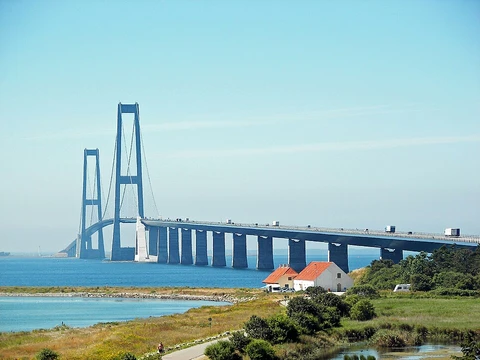
Akashi Kaikyo Bridge
Suspension bridge linking Honshu and Awaji Island, completed 1998.

via Wikipedia: Akashi Kaikyo Bridge · see source
The Akashi Kaikyo Bridge is a suspension bridge that links the city of Kobe on the Japanese island of Honshu and Iwaya, Awaji on Awaji Island. It is part of the Kobe-Awaji-Naruto Expressway, and crosses the busy and turbulent Akashi Strait. It was completed in 1998, and at the time, was the longest central span of any suspension bridge in the world, at 1,991 metres (6,532 ft). Currently, it is the second-longest, behind the 1915 Çanakkale Bridge in Turkey that was opened in March 2022. The bridge is one of the key links of the Honshū–Shikoku Bridge Project, which created three routes across the Seto Inland Sea.
- central_span
- 1,991 meters (6,532 ft)
Verified Timeline
Lore & Background
Before the Akashi Kaikyo Bridge was built, ferries carried passengers across the Akashi Strait. A major passageway for shipping, it is also known for its gales, heavy rain, storms, and other natural disasters. The Sekirei Maru sinking in stormy weather in December 1945, while carrying more than three times its capacity of 100 passengers, killed 304 people, first stirring public discussion on the possibility of a bridge over the span. In 1955, two ferries sank in the Shiun Maru disaster during a storm, killing 168 people. The ensuing shock and public outrage convinced the Japanese government to develop plans for a bridge to cross the strait. Investigations for a bridge were first conducted by the Kobe municipal government in 1957, followed by an evaluation by the national Ministry of Construction in 1959. In 1961, the Ministry of Construction and Japan National Railways jointly commissioned the Japan Society of Civil Engineers (JSCE) to conduct a technical study, and the JSCE established a committee to investigate five potential routes between Honshu and Shikoku. In 1967, the committee concluded that a bridge across the Akashi Strait would face 'extremely severe design and construction conditions, which have no similar examples in the world's long-span bridges.' In response, the Honshu–Shikoku Bridge Authority was established in 1970. In 1973, a bridge with a central span of 1,780 meters on the route was approved, but construction was halted due to poor economic conditions.
Reader's Guide
The Akashi Kaikyo Bridge is a landmark of civil engineering, representing the culmination of decades of planning and construction under extreme conditions. Its central span of 1,991 meters made it the world's longest suspension bridge upon completion in 1998, a record it held until the 1915 Çanakkale Bridge opened in March 2022. The bridge was designed with a dual-hinged stiffening girder system, allowing the structure to withstand winds of 286 kilometres per hour (178 mph), earthquakes measuring up to magnitude 8.5, and harsh sea currents. It also contains tuned mass dampers that are designed to operate at the resonance frequency of the bridge to damp forces. The two main supporting towers rise 282.8 m (928 ft) above sea level, and the bridge can expand because of heat by up to 2 m (6.6 ft) over the course of a day. Each anchorage required 350,000 tonnes (340,000 long tons; 390,000 short tons) of concrete. The steel cables have 300,000 kilometres (190,000 mi) of wire: each cable is 112 centimetres (44 in) in diameter and contains 36,830 strands of wire. The total cost is estimated at ¥500 billion or US$3.6 billion (per 1998 exchange rates). It is expected to be repaid by charging drivers a toll to cross the bridge. The toll is 2,300 yen and the bridge is used by approximately 23,000 cars per day.
Did You Know?
- The Great Hanshin Earthquake on January 17, 1995 moved the towers, increasing the central span by 1 meter to 1,991 meters.
- The bridge's steel cables contain 300,000 kilometers of wire—enough to circle the Earth nearly 7.5 times.
- The bridge can expand by up to 2 meters over the course of a day due to heat.
- The Sekirei Maru sinking in December 1945 killed 304 people and first stirred public discussion on building a bridge.
- The bridge has 1,737 illumination lights that can display 28 different color patterns for special occasions.
A Strait of Grief and the Birth of a Bridge
For decades, the Akashi Strait was crossed only by ferry, a perilous journey across a waterway notorious for violent gales, torrential rain, and devastating storms. Two catastrophic losses of life ultimately forced the Japanese government to act. In December 1945, the Sekirei Maru capsized in stormy seas while carrying more than triple its rated capacity of one hundred passengers, claiming 304 lives. A decade later, in 1955, the Shiun Maru disaster saw two ferries sink during a storm, killing 168 more. The public outrage that followed made a permanent crossing an undeniable political priority. Kobe's municipal government launched preliminary investigations in 1957, and the national Ministry of Construction followed with its own evaluation in 1959. By 1961, the Japan Society of Civil Engineers had been commissioned to study five potential routes between Honshu and Shikoku. Their 1967 findings were blunt: the Akashi Strait presented design and construction challenges with no parallel in the world's long-span bridge history. The Honshu-Shikoku Bridge Authority was established in 1970 to pursue the project, though a 1,780-metre span approved in 1973 was shelved when economic conditions soured.
Engineering Against the Elements
The bridge's structural philosophy was built around one premise: the Akashi Strait would test every component to its limit. Engineers selected a dual-hinged stiffening girder system specifically so the structure could flex under winds reaching 286 kilometres per hour and seismic events up to magnitude 8.5. Tuned mass dampers, calibrated to the bridge's own resonance frequency, further absorb and dissipate destructive forces. The two main towers, rising 282.8 metres above sea level, stand in a zone where tidal currents push water at over seven knots. To protect the underwater caisson foundations from scour, a two-metre filtering layer was installed within a ten-metre radius, then capped with eight metres of riprap. The main cables alone contain 300,000 kilometres of individual wire strands—each cable measuring 112 centimetres in diameter and housing 36,830 separate wires. Each of the two land-based anchorages demanded 350,000 tonnes of concrete. Even thermal expansion was accounted for: the entire structure can stretch by up to two metres over the course of a single day as temperatures shift.
The Earthquake That Reshaped the Span
Construction commenced in the spring of 1988, involving more than one hundred contractors, though the original vision of a combined railway-and-road crossing had been scaled back to a six-lane road-only structure. Then, on January 17, 1995, the Great Hanshin Earthquake struck with a magnitude of 7.3, its epicenter roughly twenty kilometres west of Kobe. Remarkably, the partially built bridge sustained no substantial damage, a testament to the anti-seismic methods embedded in its design. Yet the tremors were not without consequence: the two towers, the only major structures erected at that point, shifted position. The central span, originally planned at 1,990 metres, had to be extended by one metre to 1,991 metres to accommodate the displacement. Despite this mid-construction alteration, the project stayed on schedule, with structural work completing in September 1996. The bridge was formally opened to traffic on April 5, 1998, in a ceremony attended by Crown Prince Naruhito, Crown Princess Masako, and Construction Minister Tsutomu Kawara. It stood as the final great infrastructure undertaking of Japan in the twentieth century.
A Landmark of Scale and Connection
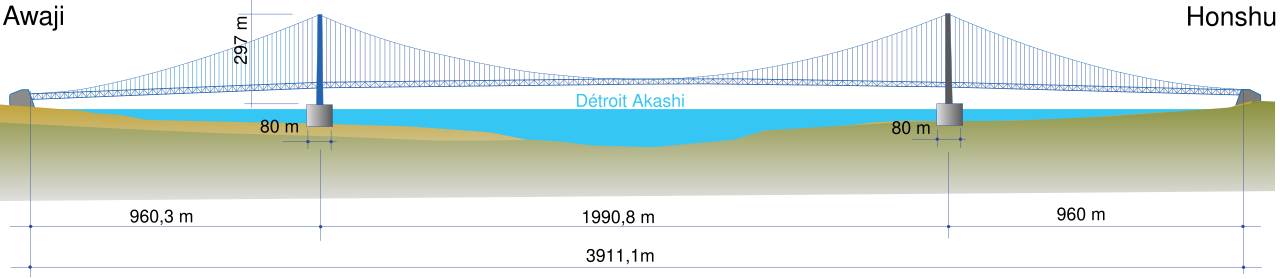
At 3,911 metres in total length, the Akashi Kaikyo Bridge stretches across the strait with a central span of 1,991 metres flanked by two side spans of 960 metres each. Upon its 1998 completion, that central span held the world record for the longest of any suspension bridge—a title it retained until Turkey's 1915 Çanakkale Bridge opened in March 2022. The structure is the easternmost link in the Honshu-Shikoku Bridge Project, a system of three routes threading across the Seto Inland Sea to connect Japan's two largest islands. It forms part of the Kobe-Awaji-Naruto Expressway, with the Ōnaruto Bridge completing the crossing by linking Awaji Island to Ōge Island across the Naruto Strait. The central span was deliberately designed to exceed 1,500 metres so that maritime shipping could continue unimpeded beneath it, with the final length chosen from a 1,950-to-2,050-metre range to balance engineering feasibility against construction cost. At night, 1,737 illumination lights—distributed across the cables, towers, girders, and anchorages—transform the bridge into a canvas of red, green, and blue light, with twenty-eight programmable colour patterns cycling through the structure.
Common Misconceptions (Editorial)
Some people may think the Akashi Kaikyo Bridge was designed with a central span of 1,991 meters, but the Great Hanshin Earthquake in 1995 actually moved the towers, increasing the span by 1 meter from its original 1,780-meter design. Others might assume the bridge is still the longest suspension bridge span in the world, but it is currently the second-longest, behind the 1915 Çanakkale Bridge in Turkey.
Why It Matters (Editorial)
The Akashi Kaikyo Bridge stands as a monument to human resilience, born from a series of tragic ferry disasters and built despite warnings of unprecedented engineering challenges. It endures not only as a vital transportation link but as a symbol of Japan’s ability to overcome natural and economic obstacles, from earthquakes to recessions, to create infrastructure that shapes national identity.
Gallery

Frequently Asked Questions
What is the Akashi Kaikyo Bridge?
It is a suspension bridge in Japan that joins Kobe on Honshu to Iwaya on Awaji Island. Finished in 1998, it held the world record for the longest main span of any suspension bridge at the time of its opening.
How long is the Akashi Kaikyo Bridge's central span?
The main span stretches 1,991 meters (about 6,532 feet) between the two main towers. That distance made it the longest central span among all suspension bridges globally when the structure was completed.
What role does the Akashi Kaikyo Bridge play in Japan's road network?
It provides a direct vehicular link between Honshu and Awaji Island, easing traffic that previously depended on ferries. It also serves as a vital segment of the broader Honshū–Shikoku Bridge Project connecting multiple Japanese islands.
Why did the Akashi Kaikyo Bridge's construction take so long?
The project was repeatedly delayed by a series of powerful earthquakes striking the region during the 1990s. Engineers had to redesign key structural elements to withstand seismic forces far beyond the original specifications before the bridge could finally open in 1998.
Why is the Akashi Kaikyo Bridge considered a landmark in engineering?
Its 1,991-meter span pushed the boundaries of what suspension-bridge technology could achieve in a highly seismically active zone. It proved that a safe, long-span crossing could be built where earlier designs would have been deemed too risky.
More in Great Bridges 1-22
Spotted an error? Know more?
This is a living reference — every entry is fact-audited, and reader corrections feed straight into our audit queue. Suggest an edit · See this site's audit record