The Millau Viaduct
The design team was led by engineer Michel Virlogeux and English architect Norman Foster.
- location
- Near Millau, Aveyron, Occitanie, France
- type
- Multispan cable-stayed bridge
- design_lead
- Michel Virlogeux and Norman Foster
- award
- 2006 Outstanding Structure Award
Lore & Background
In the 1980s, high road traffic near Millau in the Tarn valley caused congestion, especially summer holiday traffic from Paris to Spain. Bypassing Millau was considered to ease flow and improve local access. First plans for a bridge were discussed in 1987 by CETE, and by October 1991 the decision was made for a high crossing of the Tarn about 2,500 meters long. During 1993–1994, the government consulted seven architects and eight structural engineers. In January 1995, a declaration of public interest solicited design approaches. The construction contract was awarded in March 2001 to Eiffage's subsidiary Compagnie Eiffage du Viaduc de Millau.
Reader's Guide
The Millau Viaduct is part of the A75–A71 autoroute axis from Paris to Béziers and Montpellier. The bridge has been consistently ranked as one of the greatest engineering achievements of modern times and received the 2006 Outstanding Structure Award from the International Association for Bridge and Structural Engineering. The design resolved long-standing traffic congestion and provided a high crossing of the Tarn valley. The choice of the 'high solution' was decided by ministerial decree on 29 October 1991, after the low solution was abandoned due to water table issues, negative town impact, higher cost, and longer driving distance.
Did You Know?
- The design team was led by engineer Michel Virlogeux and English architect Norman Foster.
Design & Engineering Innovation
The Millau Viaduct's form emerged from an extraordinary collaborative process. When the French government opened the design question to competition, seventeen structural engineers and thirty-eight architects submitted proposals for preliminary studies. A multidisciplinary commission narrowed the field to eight engineers and seven architects, and a school of international experts chaired by Jean-François Coste helped clarify the technical and aesthetic choices. In February 1995, five general designs crystallized from the competing proposals, and the competition was relaunched around five combinations of architects and structural engineers. The design was led by French structural engineer Michel Virlogeux, who worked alongside English architect Norman Foster and the Dutch firm Arcadis, which handled the structural engineering. This fusion of French engineering pragmatism, British architectural vision, and Dutch analytical rigor produced a structure that would redefine what a road bridge could look like at such a scale.
Route Selection & Planning
The decision to build the viaduct grew out of a persistent traffic problem. During the 1980s, the Tarn valley near Millau became a bottleneck, especially in summer when holiday traffic surged along the corridor between Paris and Spain. Planners wanted to ease congestion, cut journey times for long-distance drivers, and improve access for local businesses. Four candidate routes were examined: a Great Eastern option crossing two enormous valleys, a longer Great Western route through the Cernon valley that threatened picturesque villages, a route hugging the existing RN9 road with its own technical difficulties, and an intermediate western path. Local opinion favored the western route, though geological concerns about crossing the Tarn valley initially raised doubts. The project then split into a high and a low solution. The low option, which would have descended into the valley, was ultimately rejected because it intersected the water table, harmed the town, cost more, and added driving distance. The high solution—a viaduct rising well above the river—was confirmed by decree in October 1991.
Construction & Inauguration
After the design was settled, the path to construction still required years of administrative and commercial maneuvering. In March 2001, the French construction giant Eiffage created a dedicated subsidiary, Compagnie Eiffage du Viaduc de Millau, and in August of that year it was declared the winner and awarded the prime contract. The viaduct sits within the A75–A71 autoroute axis linking Paris with Béziers and Montpellier, making it a critical artery for long-distance traffic through southern France. For the first time, drivers could cross the Tarn gorge valley at a height that transformed what had been a slow, congested descent into a single, sweeping passage above the landscape.
Legacy & Recognition
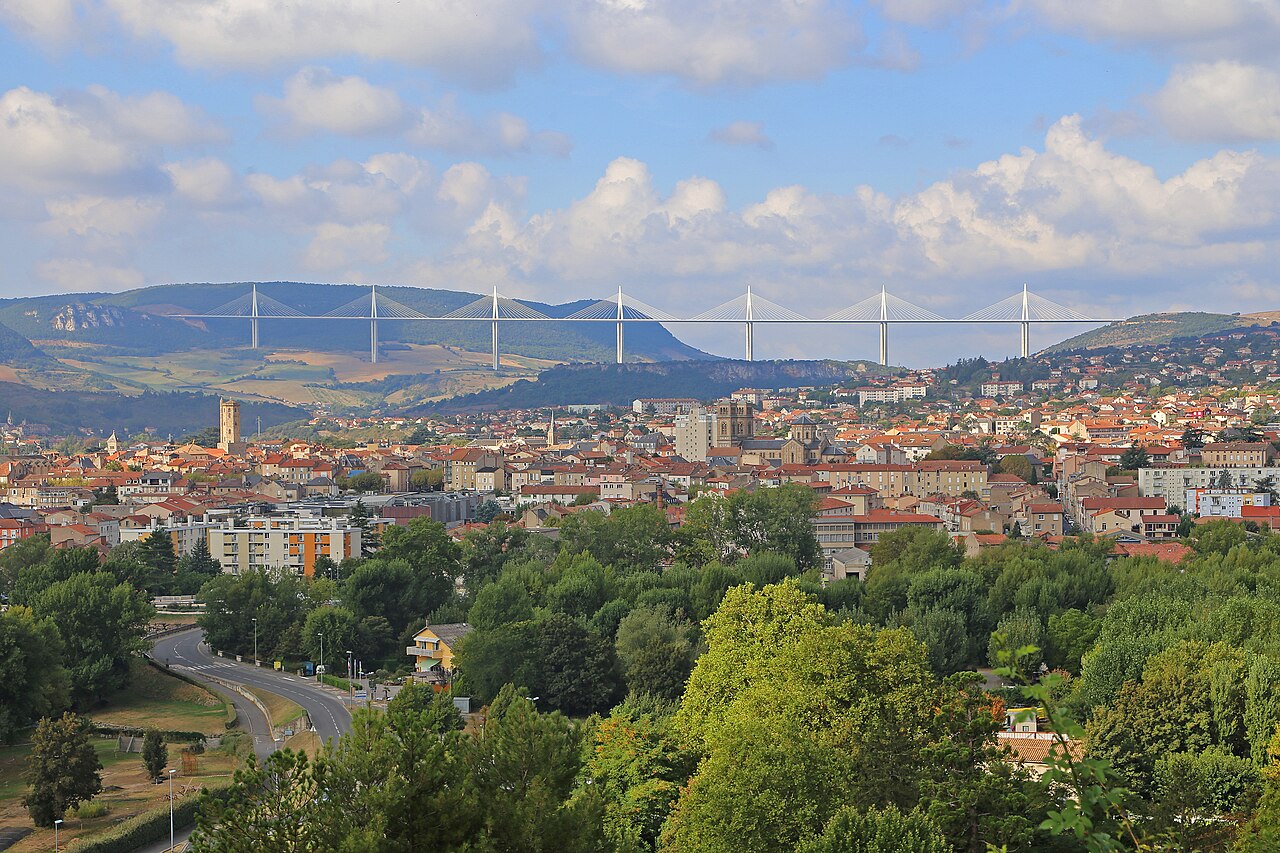
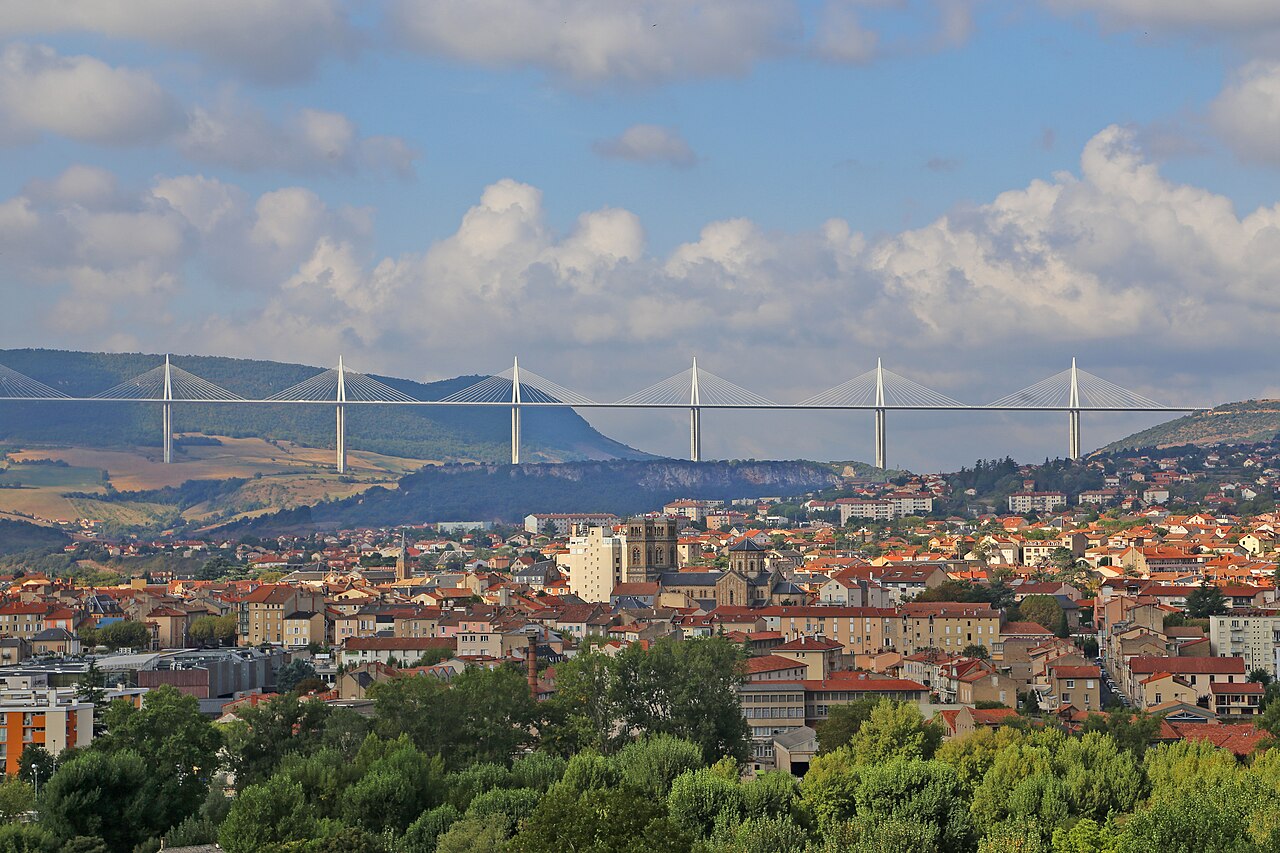
Few pieces of infrastructure have captured the public imagination quite like the Millau Viaduct. The structure's slender pylons rising from the Tarn valley floor to carry the deck high above the water created an image that became instantly recognizable around the globe. Its engineering peers recognized the achievement formally: in 2006, the International Association for Bridge and Structural Engineering presented the viaduct with its Outstanding Structure Award, a distinction reserved for works of exceptional technical and aesthetic merit. The bridge has been consistently ranked among the greatest engineering accomplishments of the modern era, a testament not only to the structural ingenuity of its cable-stayed, multispan design but also to the collaborative process that brought together French, British, and Dutch expertise. Located in the Aveyron department of the Occitanie Region in southern France, the viaduct stands as both a functional highway crossing and a landmark of contemporary engineering culture.
Common Misconceptions (Editorial)
One common misconception is that the Millau Viaduct was designed solely by a single engineer or architect; in fact, the design team was led by both engineer Michel Virlogeux and English architect Norman Foster. Another is that the bridge was built quickly with little prior planning, but the first discussions for a high crossing began as early as 1987, a declaration of public interest was issued in 1995, and the construction contract was not awarded until March 2001.
Why It Matters (Editorial)
The Millau Viaduct endures as a landmark of both engineering ingenuity and long-term infrastructure planning. It solved a persistent traffic bottleneck that had plagued the region since the 1980s, demonstrating how ambitious design can improve daily life while also becoming a source of national pride and architectural beauty.
Gallery
Frequently Asked Questions
Who designed the Millau Viaduct?
The project was led by French structural engineer Michel Virlogeux in collaboration with British architect Norman Foster. Their combined vision produced the slender concrete piers and sweeping cable-stayed deck that define the bridge's silhouette.
Where is the Millau Viaduct located?
It crosses the Tarn gorge in the Aveyron département, part of the Occitanie region in southern France. The nearest well-known town is Millau, which gives the structure its name.
More in Great Bridges 1-22
Spotted an error? Know more?
This is a living reference — every entry is fact-audited, and reader corrections feed straight into our audit queue. Suggest an edit · See this site's audit record