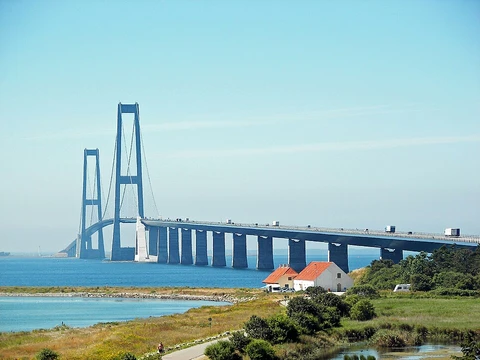
Mackinac Bridge
Longest suspension bridge between anchorages in the Western Hemisphere.

via Wikipedia: Mackinac Bridge · see source
The Mackinac Bridge ( MAK-ə-naw; also referred to as the Mighty Mac or Big Mac) is a suspension bridge that connects the Upper and Lower peninsulas of the U.S. state of Michigan. It spans the Straits of Mackinac, a body of water connecting Lake Michigan and Lake Huron, two of the Great Lakes. Opened in 1957, the 26,372-foot-long (4.995 mi; 8.038 km) bridge is the world's 32nd-longest main span and is the longest suspension bridge between anchorages in the Western Hemisphere. The bridge is part of Interstate 75 (I-75) and carries the Lake Michigan and Huron components of the Great Lakes Circle Tour across the straits; it is also a segment of the U.S. North Country National Scenic Trail. The bridge connects the city of St. Ignace to the north with the village of Mackinaw City to the south.
- opened
- November 1, 1957
- total length
- 26,372 feet (4.995 mi; 8.038 km)
- main span length
- 3,800 feet (1,158 m)
- design engineer
- David B. Steinman
- construction cost
- $100 million
- location
- Straits of Mackinac, Michigan, United States
- type
- Suspension bridge
Verified Timeline
Lore & Background
The concept of a bridge across the Straits of Mackinac was imagined as early as the 1880s, following the opening of the Brooklyn Bridge. In 1884, a store owner in St. Ignace published a newspaper advertisement with an artist's conception of the Brooklyn Bridge captioned 'Proposed bridge across the Straits of Mackinac.' At a July 1888 meeting of the board of directors of the Grand Hotel on Mackinac Island, Cornelius Vanderbilt II proposed a bridge of a design similar to the one then under construction across the Firth of Forth in Scotland. Decades passed with no formal action; in 1920, the Michigan state highway commissioner advocated a floating tunnel, and later C. E. Fowler of New York City put forth a plan for causeways and bridges using Bois Blanc, Round, and Mackinac islands as intermediate steps. Formal planning began in 1923 when the state legislature ordered the State Highway Department to establish ferry service across the strait. By 1928, the ferry service had become so popular and expensive that Governor Fred W. Green ordered a feasibility study, which estimated the cost at $30 million. In 1934, the Michigan Legislature created the Mackinac Straits Bridge Authority to explore construction and funding. The Authority twice attempted to obtain federal funds during the Great Depression but was unsuccessful. Between 1936 and 1940, a route was selected and borings were made for geological study. Work was put on hold due to World War II, and the Authority was abolished in 1947. A new Mackinac Bridge Authority was created in 1950, and engineers were retained. In January 1951, a report led the state legislature to authorize $85 million in bonds on April 30, 1952, though a weak bond market delayed issuance until 1953. David B. Steinman was appointed design engineer in January 1953. Civil engineer Abul Hasnat did the preliminary plans. Construction began on May 7, 1954, under two major contracts: Merritt-Chapman and Scott Corporation for substructure work ($25.7 million) and American Bridge Division of United States Steel Corporation for the steel superstructure (over $44 million). Construction took three and a half years (four summers, no winter construction) at a total cost of $100 million and the lives of five workers. Contrary to popular belief, none are entombed in the bridge. The bridge opened to traffic on schedule on November 1, 1957, and ferry service ceased the same day. It was formally dedicated on June 25, 1958.
Reader's Guide
The Mackinac Bridge is a significant infrastructure achievement that permanently linked Michigan's Upper and Lower Peninsulas, replacing a ferry system that could cause traffic backups up to 16 miles. At its opening, it was the world's longest suspension bridge between two anchorages, and it remains the longest such bridge in the Western Hemisphere. The bridge carries Interstate 75 and is part of the Great Lakes Circle Tour and the North Country National Scenic Trail. Its construction overcame decades of political, financial, and engineering challenges, including failed attempts at federal funding during the Great Depression and a delay due to World War II. The bridge has become a well-known symbol of the state of Michigan. It officially achieved its 100 millionth crossing on June 25, 1998, exactly 40 years after its dedication. The 50th anniversary of its opening was celebrated on November 1, 2007. The bridge also initiated the tradition of the governor leading the Mackinac Bridge Walk across it every Labor Day, started by Governor G. Mennen Williams, who was the first to pay the toll and rode the last ferry trip about an hour later.
Did You Know?
- The bridge's design was directly influenced by the 1940 failure of the first Tacoma Narrows Bridge, leading to deep stiffening trusses and an open-grid roadway to increase critical wind velocity.
- Construction took three and a half years (four summers, no winter construction) and cost the lives of five workers, but contrary to popular belief, none are entombed in the bridge.
- The bridge officially achieved its 100 millionth crossing exactly 40 years after its dedication, on June 25, 1998.
- Senator Prentiss M. Brown has been called the 'father of the Mackinac Bridge' and was honored with a special memorial bridge token created by the Mackinac Bridge Authority.
- The bridge was designated as a National Historic Civil Engineering Landmark by the American Society of Civil Engineers in 2010.
Common Misconceptions (Editorial)
- A common misconception is that five workers who died during construction are entombed in the bridge. The facts confirm that while five lives were lost, contrary to popular belief, none are entombed in the bridge. - Another misconception is that the bridge was only a recent or simple idea, but the concept was first imagined in the 1880s, with serious planning beginning in 1923 and formal proposals dating to the 1920s and 1930s.
Why It Matters (Editorial)
The Mackinac Bridge endures as a symbol of Michigan’s unity, physically linking the state’s two peninsulas and replacing a costly and unreliable ferry system with a reliable roadway. Its construction—completed on budget and on schedule despite immense engineering challenges—represents a triumph of mid-20th-century infrastructure and continues to carry Interstate 75 and millions of travelers each year.
Frequently Asked Questions
What is the Mackinac Bridge and where is it located?
It is a suspension bridge spanning the Straits of Mackinac in Michigan, physically linking the state's Upper and Lower peninsulas. Locals often call it the Mighty Mac or Big Mac.
How long is the Mackinac Bridge?
The full structure stretches about 26,372 feet (roughly five miles), with a main span of 3,800 feet between its two towers.
Who designed the Mackinac Bridge?
The design engineer was David B. Steinman, a prominent structural engineer known for several major suspension bridges.
When did the Mackinac Bridge open to traffic?
It officially opened on November 1, 1957, after a construction project that cost around $100 million at the time.
Why is the Mackinac Bridge considered significant?
It holds the record as the longest suspension bridge between anchorages in the Western Hemisphere. It also serves as a critical link on Interstate 75, connecting the two Great Lakes regions of Michigan.
More in Great Bridges 1-22
Spotted an error? Know more?
This is a living reference — every entry is fact-audited, and reader corrections feed straight into our audit queue. Suggest an edit · See this site's audit record