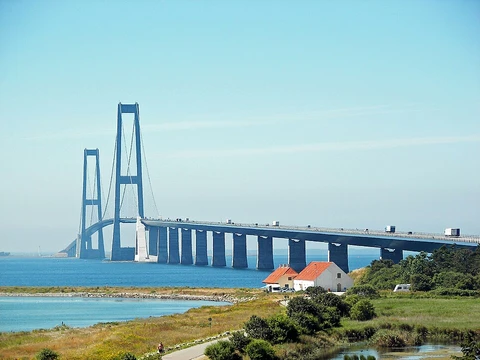
Tsing Ma Bridge
Longest rail-carrying suspension bridge, linking Tsing Yi and Ma Wan.

via Wikipedia: Tsing Ma Bridge · see source
The Tsing Ma Bridge is a suspension bridge in Hong Kong that connects Tsing Yi and Ma Wan islands. It is the world's 21st-longest span suspension bridge, and was the second longest at the time of its completion. The bridge was named after the two islands it connects, namely Tsing Yi and Ma Wan. It has two decks and carries both road and rail traffic, which also makes it the largest suspension bridge of this type. The bridge has a main span of 1,377 metres (4,518 ft) and a height of 206 metres (676 ft). The span is currently the longest of all bridges in the world carrying rail traffic. The 41-metre-wide (135 ft) bridge deck carries six lanes of automobile traffic, with three lanes in each direction. The lower level contains two rail tracks and two sheltered carriageways used for maintenance access and traffic lanes when particularly severe typhoons strike Hong Kong and the bridge deck is closed to traffic.
- Main span
- 1,377 metres (4,518 ft)
- Height
- 206 metres (676 ft)
- Width
- 41 metres (135 ft)
- Cost
- HK$7.2 billion
- Construction began
- May 1992
- Opened to traffic
- 22 May 1997
- Designer
- Mott MacDonald
Verified Timeline
Lore & Background
The Tsing Ma Bridge is the most prominent element of the Lantau Link, an infrastructure project built to connect Lantau, Hong Kong's largest island, to the urbanised areas of the territory. Until this link opened in 1997, Lantau Island could only be accessed by water, and was completely rural. The Lantau Link was built as part of the Airport Core Programme, which ultimately served to provide Hong Kong with a brand new airport at Chek Lap Kok. Construction work on the bridge began in May 1992. The Anglo Japanese Construction Joint Venture, comprising Costain, Mitsui, and Trafalgar House, won the job. The first steel deck segment was lifted into place in late 1994. Construction was finished in May 1997. It cost HK$7.2 billion. The Lantau Link was inaugurated on 27 April 1997 by former British Prime Minister Margaret Thatcher. Security was extremely tight as Thatcher was considered one of the top targets of the Irish Republican Army. The commemoration ceremony began with a flotilla of police and other government vessels passing beneath the bridge, before Government Flying Service and Royal Air Force aircraft flew above the concrete towers. Thatcher, Chief Secretary Anson Chan, and Governor Chris Patten then switched on the bridge lights and drove across the span with other dignitaries. The celebration concluded with a 20-minute firework and laser show, featuring fire pouring from the length of the bridge. The opening ceremony attracted more than 100,000 spectators, most of them standing along Castle Peak Road, which was closed to road traffic. More than 2,300 police officers were deployed, and the crowd control exercise was studied by the police for its relevance to the upcoming Handover ceremony. Three boating accidents occurred during the bridge inauguration. The Lantau Link was opened to traffic on 22 May 1997 at 8:00 am. The first road accident on the Lantau Link occurred on the Tsing Ma Bridge on 23 May 1997. Two motorcyclists were injured in a collision with a lorry.
Reader's Guide
The Tsing Ma Bridge crosses the Ma Wan Channel, linking the islands of Tsing Yi and Ma Wan. It is part of the Lantau Link, which links the New Territories and Lantau Island, and eventually leads to the Hong Kong International Airport on Chek Lap Kok via the North Lantau Highway. The bridge is part of the Route 8 expressway. The rail line is shared by the MTR's Tung Chung line and Airport Express. The bridge, together with other highway, bridge and tunnel connections in the area, are part of the Tsing Ma Control Area under the Tsing Ma Control Area Ordinance (Cap. 498) in Hong Kong Law. Along with the Ting Kau Bridge and Kap Shui Mun Bridge, the bridge is monitored by the Wind and Structural Health Monitoring System (WASHMS). Surveillance cameras are also installed on the bridge to record traffic conditions. There are no longer tolls on Lantau Link since 27 December 2020. The normal speed limit on the bridge is 80 kilometres per hour (50 mph), subject to lowering in the event of road work or strong wind. Traffic may also be directed to the sheltered carriageways on the lower deck when there are very strong winds. There are no pavements on the bridge. The bridge was designed by Mott MacDonald. The designers were inspired by the Forth Bridge in Scotland and the Severn Bridge in England. Wind tunnel testing used a 1 to 400 scale full aeroelastic model of the entire bridge, a Monte-Carlo simulation of the typhoon wind climate. The model tests identified critical stages of erection that allowed the construction schedule of the bridge to be tailored to avoid the typhoon season.
Did You Know?
- The Tsing Ma Bridge was the second longest suspension bridge in the world at the time of its completion.
- The bridge's span is currently the longest of all bridges in the world carrying rail traffic.
- The climbing cranes used to erect the tower portals were coincidentally also used on the HSBC Main Building a decade earlier, as well as at Canary Wharf in the interim.
- The bridge was inaugurated by former British Prime Minister Margaret Thatcher on 27 April 1997, with security extremely tight due to her being considered a top target of the Irish Republican Army.
- Tolls on the Lantau Link were removed on 27 December 2020.
Common Misconceptions (Editorial)
Some people mistakenly believe the Tsing Ma Bridge carries only road traffic, but it actually has two decks and carries both road and rail traffic, including the world’s longest span of any bridge carrying rail traffic. Another common error is that the bridge was named after British officials or engineers; in fact, it was named after the two islands it connects, Tsing Yi and Ma Wan.
Why It Matters (Editorial)
The Tsing Ma Bridge endures as a symbol of Hong Kong’s ambition and rapid modernization, marking the transformation of Lantau Island from a rural backwater into a gateway linked to a world-class airport. Its dual-purpose design — carrying road and rail through typhoon-prone waters — remains an engineering benchmark, while the dramatic inauguration attended by Margaret Thatcher underscores the bridge’s role in Hong Kong’s final years under British rule.
Frequently Asked Questions
What is the Tsing Ma Bridge?
It is a major suspension bridge in Hong Kong that spans the water between Tsing Yi and Ma Wan islands. As part of the Lantau Link project, it links Lantau Island to the territory's more densely populated districts.
How big is the Tsing Ma Bridge?
Its main span stretches 1,377 metres (4,518 ft) between the two towers, which rise 206 metres (676 ft) above the water. The deck is 41 metres (135 ft) wide, wide enough to carry both road and rail traffic.
What world record does the Tsing Ma Bridge hold?
It is the longest suspension bridge in the world that carries a railway line. At its 1997 opening it also ranked as the second-longest suspension span ever built at that time.
When was the Tsing Ma Bridge built and opened?
Construction began in May 1992 and the bridge was opened to traffic on 22 May 1997. The entire Lantau Link project cost roughly HK$7.2 billion.
Why is the Tsing Ma Bridge important for Hong Kong?
It serves as a critical gateway to Hong Kong International Airport, carrying both vehicular and rail traffic to and from Lantau Island. Without it, the airport and the western districts would lack a direct road-and-rail connection to the rest of the territory.
More in Great Bridges 1-22
Spotted an error? Know more?
This is a living reference — every entry is fact-audited, and reader corrections feed straight into our audit queue. Suggest an edit · See this site's audit record