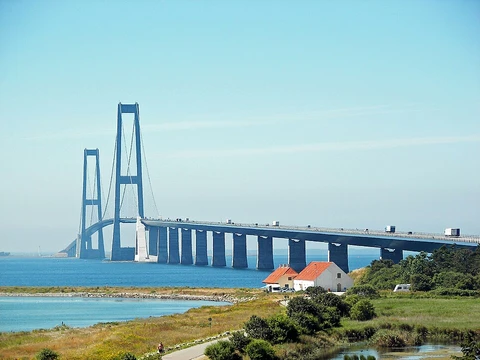
Verrazzano-Narrows Bridge
Suspension bridge linking Staten Island and Brooklyn across the Narrows.

via Wikipedia: Verrazzano–Narrows Bridge · see source
The Verrazzano–Narrows Bridge is a suspension bridge connecting the boroughs of Staten Island and Brooklyn in New York City, New York, U.S. It spans the Narrows, a body of water linking the relatively enclosed New York Harbor with Lower New York Bay and the Atlantic Ocean, and is the only fixed crossing of the Narrows. The double-deck bridge carries 13 lanes of Interstate 278: seven on the upper level and six on the lower level. The span is named for Giovanni da Verrazzano, who in 1524 was the first European explorer to enter New York Harbor and the Hudson River. The bridge opened on November 21, 1964, and the lower deck opened in 1969.
- type
- Suspension bridge
- location
- New York City, New York, U.S.
- main_span
- 4,260 feet (0.807 miles; 1.30 kilometers)
- lanes
- 13 (7 upper, 6 lower)
- opened
- November 21, 1964 (upper deck); 1969 (lower deck)
- named_after
- Giovanni da Verrazzano
- longest_span_when_built
- Longest suspension bridge main span in the world until 1981
Verified Timeline
Lore & Background
Engineer David B. Steinman proposed a bridge across the Narrows in the late 1920s, but plans were deferred over the next twenty years. A 1920s attempt to build a Staten Island Tunnel was aborted, as was a 1930s plan for vehicular tubes underneath the Narrows. Discussion of a tunnel resurfaced in the mid-1930s and early 1940s, but the plans were again denied. In the late 1940s, urban planner Robert Moses championed a bridge across the Narrows as a way to connect Staten Island with the rest of the city. Various problems delayed the start of construction until 1959. Designed by Othmar Ammann, Leopold Just, and other engineers at Ammann & Whitney, the bridge opened on November 21, 1964. The lower deck opened in 1969 to accommodate increasing traffic loads. The bridge was refurbished in the 1990s and again in the 2010s and 2020s. When the bridge was officially named in 1960, it was misspelled "Verrazano–Narrows Bridge" due to an error in the construction contract, though the name was not corrected until 2018.
Reader's Guide
The Verrazzano–Narrows Bridge has a central span of 4,260 feet (0.807 miles; 1.30 kilometers). Its central span was the longest of any suspension bridge in the world until the Humber Bridge was completed in 1981. The bridge has the 18th-longest main span in the world, as well as the longest in the Americas. The bridge collects tolls in both directions. From 1986 to 2020, in an attempt to reduce traffic congestion, only westbound drivers paid a toll (which was double the standard toll for several of the city's other bridges). Early plans for a crossing included the "Liberty Bridge" proposed in the late 1920s, which was blocked by then-Congressman Fiorello H. La Guardia, who believed that a public necessity should not be provided by private interests. The bridge's construction overcame decades of debate and opposition, including multiple tunnel plans that were denied or canceled.
Did You Know?
- The bridge's central span of 4,260 feet was the longest of any suspension bridge in the world until the Humber Bridge was completed in 1981.
- When officially named in 1960, the bridge was misspelled "Verrazano–Narrows Bridge" due to an error in the construction contract; the name was not corrected until 2018.
- From 1986 to 2020, only westbound drivers paid a toll, which was double the standard toll for several of the city's other bridges, in an attempt to reduce traffic congestion.
- The bridge is the only fixed crossing of the Narrows.
- Engineer David B. Steinman first proposed a bridge across the Narrows in the late 1920s, but plans were deferred for twenty years.
Common Misconceptions (Editorial)
Some people believe the bridge was originally named correctly with one "z" and later changed, but it was actually misspelled "Verrazano" in the construction contract when officially named in 1960, and the name was not corrected to "Verrazzano" until 2018. Others assume the lower deck opened at the same time as the upper deck, but the lower deck did not open until 1969, five years after the upper deck. It is also sometimes thought that the bridge's main span remains the world's longest, but it held that title only until 1981, when the Humber Bridge was completed.
Why It Matters (Editorial)
The Verrazzano-Narrows Bridge matters not only as a vital transportation link uniting Staten Island and Brooklyn, but also as a monument to mid-century ambition and the vision of urban planners like Robert Moses. Its history—spanning decades of deferred plans, engineering triumphs, and even a decades-old spelling error—reflects the complex, often imperfect process of building a city that endures and adapts over time.
Frequently Asked Questions
Who is the Verrazzano-Narrows Bridge named after?
The bridge honors Giovanni da Verrazzano, the Italian explorer who became the first European to sail into New York Harbor back in 1524.
What type of structure is the Verrazzano-Narrows Bridge and where is it located?
It is a suspension bridge in New York City that links Staten Island to Brooklyn by spanning the Narrows, the stretch of water connecting New York Harbor to the Atlantic. It serves as the sole permanent crossing over that waterway.
How long is the Verrazzano-Narrows Bridge's main span and how many lanes does it carry?
The main span stretches 4,260 feet (roughly 1.3 km), making it one of the longest suspension spans in the world. The bridge accommodates 13 lanes of traffic split across two decks—seven on the upper level and six on the lower.
When did the Verrazzano-Narrows Bridge open to traffic?
The upper deck first carried vehicles on November 21, 1964. A second, lower deck was added five years later in 1969 to handle growing traffic volume.
Why is the Verrazzano-Narrows Bridge considered important?
As the only fixed crossing of the Narrows, it is the sole permanent road link between Staten Island and Brooklyn, carrying Interstate 278 across the waterway. Without it, residents of Staten Island would have no direct highway connection to the rest of New York City.
More in Great Bridges 1-22
Spotted an error? Know more?
This is a living reference — every entry is fact-audited, and reader corrections feed straight into our audit queue. Suggest an edit · See this site's audit record